Sunday, September 26, 2010

Wan Chai

I moved to HK island. I had arranged to have a couple of nights in a boutique hotel in Wan Chai (Little Bay) for a change of scenery. I'm glad I did, I couldn't bear 5 nights in Mongkok. But first breakfast, and then after that, to compare egg tarts from two shops. It's very important to do these comparisons, you know.


The last time I was in HK, foot passengers crossed Victoria Harbour using a Star Ferry although there was road tunnel already. After that visit, the Tseun Wan MTR line connected HK island with Kowloon. That tells you how long ago it had been.


Wai Chai is visibly less hectic and more upmarket than Mongkok. But space is still at a premium. Can we interest you in a skinny apartment?


I left my backpack with the hotel because it was not check-in time yet and took a tram ride to the Western Market. If you get an upper deck seat, it's a scenic way to view HK. Advertisers have also not failed to notice that they make great moving billboards. I'll create a gallery with many of the specimens I took pictures of.


This market specialises in luxury fabrics. Unfortunately I have no such interests. The interior of the building is historical.


A somewhat unfortunately named business, to Aussies at least.


Central is full of posh shopping centres with famous brand names. I can only afford to look.


It was time for lunch so I went to the Luk Yu Tea House which has been around longer than I have. Some of the waiters look as old as the establishment. There was a murder here in November 2002 when a property tycoon was killed at breakfast by a hitman. Fear not, homicide in HK is quite low by world standards, aggravating crowded shopping centres notwithstanding. More murders happen in HK films than in real life.


The fare was standard and quite good. But there was a twist with siew mai, it came with slices of liver. The only way I like liver is in pâté so I had to leave that.


Then to see the Mid-levels Escalator. This is a chain of public covered escalators going from Central to mid-levels, the side of a hill. Commuters use it to go down to Central in the morning, and for the rest of the day, the direction of the escalator is reversed. I rode the escalator to the end, and then caught a minibus down.


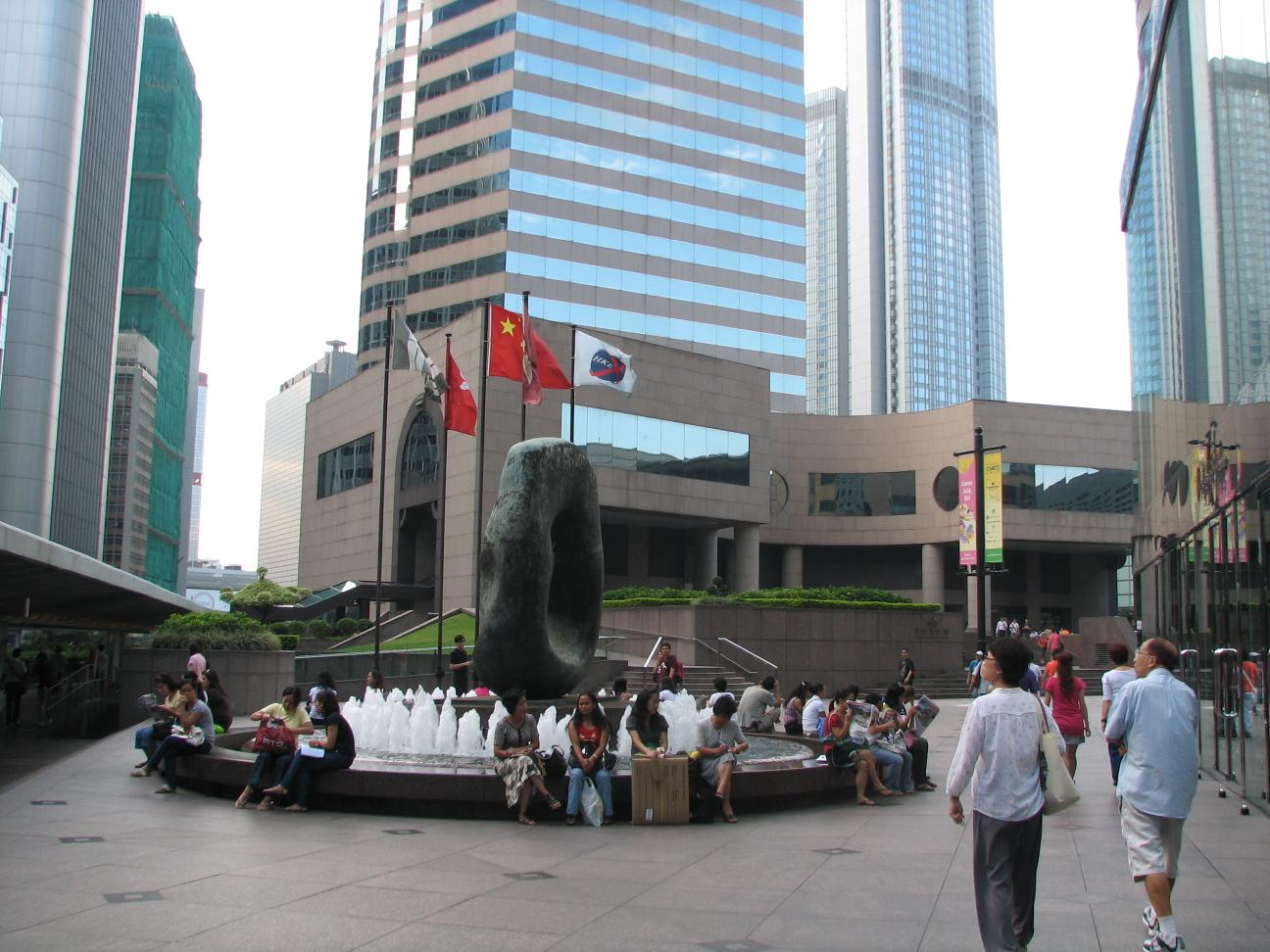
While having an afternoon coffee break in the plaza near Hong Kong terminal, I noticed that many foreign maids (I think) were there relaxing on a Saturday, chatting, texting, or even surfing the web with 3G modems. These workers are very visible in HK, you will see a lot of them on public transport and in shopping centres on weekends and public holidays, when presumably they get time off.


I verified that I could check in my backpack at the Central terminal of the airport service on the day of departure, saving me having to carry it to the airport, and more important, having to store it until the evening.


Then it was time to rest my tired frame in the hotel. This hotel has a nice collection of historic photographs on the wall, from the early days onwards. Life was definitely harder in those days. You wouldn't want to be a coolie then. (It so happens that the Chinese rendition of coolie translates to bitter strength. Quite apt.)

Saturday, September 25, 2010

Tsim Sha Tsui

I had hoped to complete entry formalities in ½ hour so that I would get to Tsim Sha Tsui Promenade in time for the sound and light show. Unfortunately the immigration officials seemed to be less efficient than the traders of Hong Kong, so the queue was long. I got there too late for the show, or perhaps it hadn't happened at all. By the way the building with the triangles is the Bank of China.


But there was something just as good. They had an exhibition of mid-autumn festival lanterns illustrating HK life.


After that I went to a recommended Malaysian restaurant in East TST. The fried radish cake was credible but a bit gooey rather than firm. Still, not a bad effort.

Macau

I had scheduled a day trip to Macau simply because I had never been there before and I was curious about this geopolitical anomaly which was quietly handed back to China in 1999, after the HK handback, which got all the attention in 1997. Macau, like HK, has been granted a 50 year continuation of the current administrative system and is thus also a SAR. I was under the impression that Macau is an island but it's a peninsula joined by an isthmus to the mainland, and a couple of islands, Taipa and Coloane. There are 3 spectacular road bridges to Taipa.


Macau certainly has one of the more obscure currencies of the world, the pataca. Did you know that? I didn't. It's pegged at 1.03 per HKD so visitors can use HK currency and the recipient gains 3% in the exchange. Why did they bother to create their own currency though? I also didn't know before that the ISO country code for Macau (in URLs for example) is mo.


The trip took just over 60 minutes by jetboat. There was no opportunity to go on deck, and we were in fact required to stay in our seats whenever possible. So it was like a short airline flight, and felt even more so, given the border formalities on both sides. It counts as an external destination, and my passport was required. I had left HK, entered Macau, left Macau, and reentered HK, all on the same day.


As we approached the harbour, a fake walled Chinese city and hill hove into view. This was the first indication that Macau is into the fantasy tourism business. The many casinos there look like they could have been teleported from Las Vegas. According to statistics, it is a big money earner for the Chinese government, in fact recovering the spending of its citizens who gamble there, and a significant number of residents work in the casino industry. Certainly the short-skirted girls who were trying to entice visitors to board the free shuttles to the various casinos were.


I was hoping that the weather would be cooler than HK, but no such luck. If anything it was warmer. I needed to get out of HK for a while though. The night before, the crowds in the Sham Shui Po computer centre made me feel homicidal.


I boarded a public bus bound for the centre. Public signs were bilingual, in Chinese and Portuguese. Do shop owners know enough Portuguese to write their signs? Probably the signwriter takes care of that for them and anyway there are only a finite number of shop types: restaurant, bakery, hardware supplies, etc. I also wondered if Portuguese was on the curriculum for all school students in Macau. It felt a bit odd for me to be able to understand Portuguese in Asia. The other place in Asia where Portuguese is still used is I believe East Timor. However, according to Wikitravel, Portuguese is not spoken by most people. In fact I only heard it once between a couple of schoolkids of visibly Portuguese descent. So Cantonese was what I used.


Seeing a bunch of people get off the bus I jumped to the conclusion that this was the centre and hopped off. I was mistaken. I was in the middle of an unknown part of Macau, surrounded by high rise tenements. The canyons made it impossible to work out where I was in on the map. I wasn't too worried though. Macau is a small place and worst come to worst I could hail an taxi. Spotting a dim-sum shop I joined the queue to buy some take-away siew mai and bamboo shoots wrapped in tofu.


Everything looked old and worn out there. It's like I'd been teleported in time to an older version of HK.


I finally reached an open space with a large building at the end and this turned out to be Portas de Cerco, the border crossing into China. (Apparently a lot of tourists are from China.) I had in fact been wandering in a old residential quarter of Macau. I plonked myself on the floor at the furthest corner of the air-conditioned departure hall, where several other people were also sitting, and ate my lunch.


After that I went to the bus station adjacent and caught a bus to Macau Tower where I took the lift to the 58th level. There I got a good idea of the layout of Macau and could see China in the hazy distance.


There are various exciting activities outside the tower, ranging from a tethered walk, to bungee jumping.


Then it was down to the ground and a walk to the historic centre, where there were lots of visitors. This part of Macau is more modern and what one would expect of a 21st century city. There seemed to be some kind of mid-autumn festival celebration happening there.


The post office seemed to be doing good business in philatelic products.


The casinos here have out-of-the-world shapes, like this one.


I found the recommended Portuguese cafe and had a maça asada (baked apple) and orange juice for tea break.


Then it was back to the jetboat for the return trip. We arrived after dusk.


I still don't know what to make of Macau. It certainly is an odd place. I'll have to read up more on it.


(The evening's story will be continued in HK.)

Friday, September 24, 2010

The speed of business

Jan Morris once caricatured Hong Kong in a 1959 piece thus: More people live in Hong Kong that the rest of the world put together, and they make more noise than a million electric drills, and they work like automation, and their babies are beyond computation, and their machinery chitter-chatters away for twenty-five hours every day, and in their markets they sell every fish that was ever caught, and every shrimp that ever wriggled, and every crab that ever pinched, and their excellent shirts cost fourpence-ha'penny apiece, and there are five million Chinese for every European in the city, each one of them more energetic than a power station: and all these unbelievable paradoxes of prolixity and profusion are a lesson in the impermanence of power and the mutability of history.


It's not so far from the truth. Nothing reminds me so much of etiolated plants as HK people, all struggling to succeed on an overcrowded piece of rock where the most abundant resource is human power and ingenuity. So everybody is on the move, move, move here. If you don't squeeze past people in crowded venues, then other people will squeeze past you. When the Beatles wrote the hit Can't Buy Me Love, Hey!, a Cantonese version came out, set to the same tune, entitled Haang Fai Dit La, Wei! (Hey! Walk a Bit Faster). I think that epitomises HK so well.


Of course, manners get a bit, er, streamlined in the process. None of that lengthy Japanese patter. The difference is like heaven and earth. Most of the time you'll get just Thanks at the cashier, sometimes you'll just get your change in silence. Don't think though that HK people are rude or taciturn. If you are examining the goods, the vendor will engage you with a view to closing the sale quickly. But fear not, if you make your needs clear, you can be sure that they will do their best to find something that suits you. And after all that's what successful business is about, giving the customer what they want.

Mongkok

I've decided to start the morning in Tsim Sha Tsui (Sandy Point), or TST, and walk back along Nathan Road to Mongkok. After having a breakfast of century old egg porridge in a shop just downstairs that's open 24 hours, I caught the MTR (subway) to TST. At this early hour of the morning, only street sweepers and delivery people are up and about. HK is a night city and retail doesn't start until about 10 or 11 am.


Gelato mooncake, what an innovative synthesis of east and west.


It used to be that HK was mostly Cantonese speaking, but now I can hear different dialects, e.g. Mandarin, Shanghainese, probably from mainland China; even different languages spoken. You can certainly see that people from many countries have come here to make a living. Turning a corner in TST, I came across this group of what I think were Filipina workers chatting and texting.


In humid weather you walk at a medium pace trying not to generate unnecessary body heat until you can reach the next air-conditioned oasis, usually a shopping centre. After a while the cool air dries you out and you repeat the cycle. In this spanking new centre which appeared to be trying to gather enough retailers to have a grand opening, I found a coffee shop with a distant view of the peak on HK island.


HK is full of old-fashioned dry goods stores, selling dried scallops, fish, birds nest, figs, herbs, etc. I think many customers buy supplies in bulk to take home to last until their next trip here.


About noon, the hawkers on Ladies' Street (Tung Choi Street) were beginning to set up. True to its name, it sells mostly women's clothing and accessories, although I was able to get a couple of pairs of jeans and some shirts here.


I got a lunch of wonton noodles at a place called Good Hope Noodles. Al dente noodles like they should be.


A refreshing drink of fresh coconut juice here.


Similar Chinese businesses like to cluster. You will find whole streets devoted to footwear, building supplies and so forth. And of course there are the computer centres. Walking down one street, I had pamphlets for home renovation thrust at me. It might sound like a poor strategy to be near your competitors but the Chinese are not worried; they believe that the customer likes to be overwhelmed by choice and thus encouraged to buy. Certainly seems to work.


This is a different market, Temple Street Market, which has different goods than the mostly womens goods in the Ladies Market. I found cheap T-shirts and boxer shorts here.


I made a trip to Sham Shui Po where there is the mother of all computer markets: hundreds of stores crammed into one building where you can get any techno toy.

Thursday, September 23, 2010

Chek Lap Kok

This was my second time in Chek Lap Kok airport, the first was 3 weeks ago Hokkaido-bound. The last time I visited HK, Kai Tak was still the airport, i.e. quite a long time ago. I was therefore curious about what HK was like now, and also intended to undergo some retail and food therapy after Hokkaido.


HK International Airport is very impressive and efficient, and you can read all about it from the links, but I'll continue with my trip. As soon as I walked out of the terminal, the humidity hit me. Mercifully the temperature was around 26C, down from the 30s a few weeks ago. On the bus I overheard a Cantonese couple bantering and a group of American girls chatting in their nasal accents. You notice when your mind tries to make sense of overheard sentences, which it couldn't do in Japan, so it just relaxed.


The airport bus dropped me in Mongkok about ½ hour later. You notice right away that even though it's night, it's as bright as day due to the artificial light of hundreds of advertising signs and shop lights. And even though it's around 2200, the streets were thronged with a mass of humanity walking, talking, looking, working, nattering away into their mobiles, or texting.


It took a little time to find the entrance to the building for the hostel because the street signs are non-existent or hard to find; the locals just know what street they are on. The hostel rooms are actually rooms within apartments. Thus a hostel may span many apartments within the high-rise. Down near the harbour, in Tsim Sha Tsui, is Chungking Mansions, synonymous in the backpacker dictionary with cheap to tolerable dives. I had picked Mongkok to be closer to the shopping action. The room's just under twice the width of the bed, but has air-conditioning and an attached bathroom/toilet so small that when I shower the spray wets the seat.


You don't want to look too closely at the back streets and other dark corners of HK or you will get sanitary revulsion. That's the price of the extreme population density of HK.

What I would do different

I would reduce the length of my trip from 3 weeks to 2. In Japan it is possible to make tight connections, and also some tourist spots can be seen in passing—you don't have to stay there a full day.


I would consider going in the spring rather than autumn because of the wildflowers.


I would omit the parts of Hokkaido below Sapporo and Otaru. Tōya-ko is not spectacular and Noboribetsu I've heard is tacky. The only thing I would miss about Hakodate is the seafood. But the first time you want to see everything.


I would use a rental car more to go to small places not served well by public transport. Of course there is cost to this but just hanging around in Japan also costs money.


I would be more willing to use hotels since the prices for single rooms aren't that much more than hostel accommodation. The drawbacks are that you have to arrange your own meals, and you don't get to meet other travellers.


I would learn Hiragana to at least be able to read place names and common terms.


And some comments:


Japan is a small county with a large population and settled all over.  Even in the wilds you are never too far from civilisation. So the outdoors can be tame compared to bigger countries in say the Americas.


Japanese culture is quite similar all over. Sure, if you are a native, there are things that slightly different in your nook of Japan, and there are regional differences in food. But the modern aspects of Japan are the same all over. In Europe, if you go a couple of hundred km, you are in a different country.


There isn't a heavy backpacker trail in Hokkaido. I met few non-Japanese travellers, whereas in say SE Asia, you would be tripping over them in hostels. There is a lot of internal tourism and this means that things are geared towards the Japanese, i.e. the brochures, the signs, the facilities. However there are signs of change, there are backpacker hostels in Sapporo and Otaru that advertise on the Internet.


Finally probably a prejudice of mine: Most of the history I know is Eurocentric because Europe has dominated history for last half a millennium. Japan was a late comer to the world stage. So I don't have much interest in Japanese history and all related things: buildings, temples, shrines, sacred spots. That leaves only scenic spots.